
Products
Related content
- Apr 27, 2026Air Energy Train Washing EquipmentDiscover energy-saving air energy train washing equipment that integrates AI & heat pump tech for eco-friendly, efficient cleaning of EMUs, subways & rail vehicles.
- Mar 09, 2026Mobile Intelligent Train WasherDiscover the mobile intelligent train washer, a fully automated solution for cleaning EMU, subway, and conventional trains. Features AI vision, high-speed brushes, and eco-friendly water recycling.
- Feb 03, 2026Working Principle of Engineering Car WasherDiscover how the engineering car washer uses infrared sensors and high-pressure spraying for fully automatic vehicle cleaning. Features water recycling for eco-friendly operation.
- Jan 25, 2026Engineering Car WasherFully automatic engineering car washer for construction vehicles. Removes mud, dust & debris with high-pressure spray. Ideal for sites, mines & ports. Eco-friendly & durable.
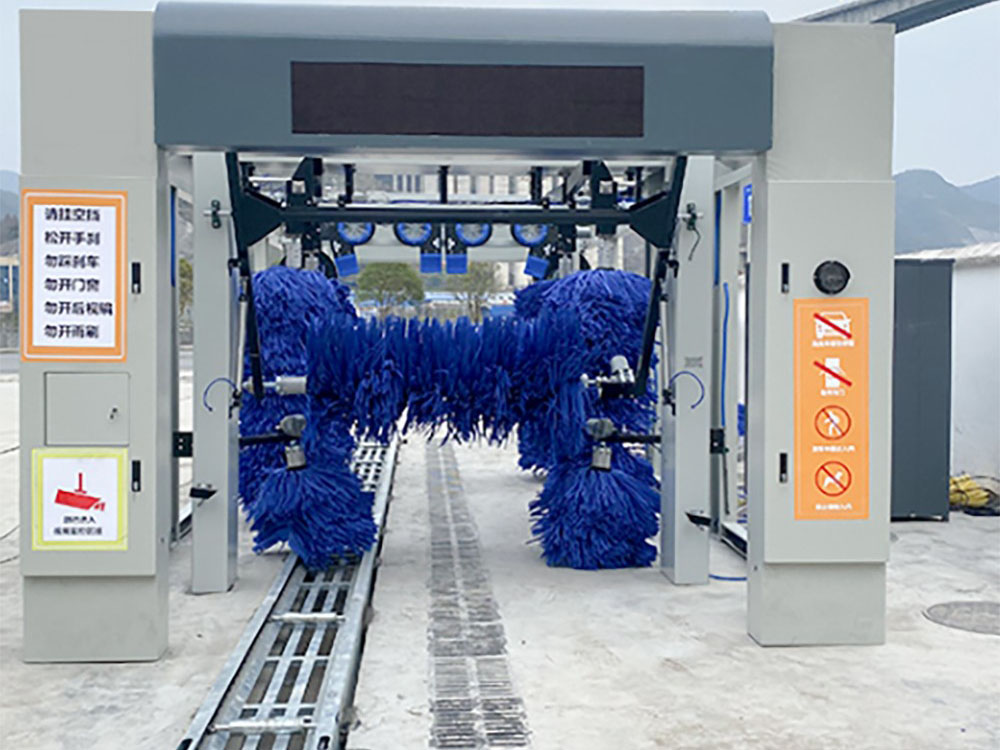
The reciprocating high-speed car washing machine is also called gantry type car washer. The vehicle stays stationary, while the gantry frame equipped with washing and drying modules moves back and forth along the track. It completes full-body washing and air drying in one or two round trips, featuring small footprint, fast speed, intelligent profiling and high cost performance.
2. Working Principle & Structure
● Working Mode: Vehicle stationary, machine moving. Track length: about 7.5–9 m; occupied space: about 6–10m × 3.3m.
● Main Components:
Gantry frame & traveling drive (variable frequency speed regulation, high-speed reciprocating movement);
Profiling brushes: 1 top brush, 2 side brushes, 2 skirt brushes (wheel hub brushes optional);
High-pressure pre-washing, foam and wax coating system;
High-speed air drying: 3–4 top air knives + 2 side air knives with profiling lifting function;
Intelligent control: PLC + photoelectric/radar sensor, automatic vehicle recognition and profiling track operation.
3. Key Parameters (High-Speed Model)
● Washing time: 1.5–2 minutes per car for quick wash (one round trip); 2–3 minutes for standard wash (two round trips).
● Working efficiency: 15–25 vehicles per hour, higher than ordinary reciprocating type, lower than tunnel type.
● Power & energy consumption: 380V three-phase power; power consumption: 0.8–1.2kWh per car; water consumption: about 180–220L per car (water recycling system optional).
● Applicable vehicles: Length ≤5.3m, width ≤2.1m, height ≤2.05m, suitable for sedans, SUVs and MPVs.
4. Core Difference from Tunnel Car Washer
● Reciprocating High-Speed Type: Vehicle stops, machine moves; small footprint 6–10m; moderate price; ideal for daily 50–150 cars, limited site and medium budget, widely used in gas stations, community car washes and 4S stores.
● Tunnel Type: Machine fixed, vehicle driven by conveyor chain; long occupied length 25–35m; high price; suitable for daily over 200 cars and high-traffic locations.
5. Advantages and Disadvantages
● Advantages
Small footprint, only 1/3–1/2 length of tunnel type, perfect for urban and old station renovation.
Fast washing speed, only 1.5 minutes for quick wash, close to tunnel efficiency.
Accurate intelligent profiling, photoelectric sensor adapts to vehicle shape, brushes and air knives fit closely without paint damage.
Low overall cost, lower equipment, installation and maintenance cost than tunnel type with simple operation.
Flexible and stable, supports unattended operation and remote monitoring; no conveyor chain jamming risk and low failure rate.
● Disadvantages
Continuous throughput is lower than tunnel type, easy to queue in peak hours.
Air drying effect is slightly weaker; air knife quantity and power are less than tunnel type, manual supplementary drying needed for corners.
6. Common Faults and Troubleshooting of Air Drying System
● Weak wind and poor drying effect
Check blocked air duct and air outlet, offset air knife angle, loose belt, motor power attenuation and air leakage of aging sealing strips. Clean air duct, calibrate and lock air knife angle, tension or replace belt, repair motor and replace sealing strips.
● Air drying system not starting or tripping frequently
Check three-phase power phase loss, damaged contactor/thermal relay, loose circuit, burned motor and no PLC control signal. Restore power supply, replace damaged electrical parts, fasten wiring terminals, test motor insulation and check sensors and PLC program.
● Abnormal noise and severe vibration
Impeller dirt accumulation and unbalance, worn bearings lacking lubrication, loose frame screws and mechanical resonance. Clean impeller for dynamic balance, replace bearings and fill with high-temperature grease, tighten base and bracket screws, install shock-absorbing pads.
● Water dripping and water accumulation in air duct
Blocked drain holes, poor sealing, rainwater backflow and insufficient air duct slope. Unblock drain holes, strengthen sealing of duct joints, adjust air duct slope for natural drainage.
7. Applicable Scenarios
● Urban gas stations, community car washes, underground parking lots with site length within 10m.
● 4S stores and auto repair shops, balancing washing efficiency and operating cost.
● Sites with daily 50–150 vehicles, budget 100,000–150,000 and pursuing quick investment return.


